Today's vehicles are more powerful, more efficient and safer than ever before. In fact, today's car buyer would be hard pressed to spend his or her money on a genuinely bad vehicle. But those overall improvements may have also led consumers to believe there are no real differences between the various products offered by the world's major automakers. According to the Consumer Reports 2012 Car-Brand Perception Survey, Toyota, Ford, Honda and Chevrolet have all seen their scores drop by double digits compared to last year.
The survey asks consumers to rate brands across seven categories. Consumer Reports says that by combining those categories, the organization can get a handle on how each brand is perceived in the marketplace.
This year, Toyota continued to lead in the survey, though its persistent recalls saw the brand's perception fall by 17 points this year. Ford, Honda and BMW all saw their perception scores plummet more than 20 points. The results may indicate consumers are seeing fewer differences between automakers as products continue to improve. While that's good news for smaller automakers like Hyundai, Kia and Subaru, larger names in the industry should be worried. Head over to Consumer Reports for the full report.
Monday, January 30, 2012
Is Tony Starks new Acura a precursor to next NSX?
When the upcoming Marvel reunion The Avengers hits the silver screen, it promises to be packed with action. Action heros like Iron Man, The Incredible Hulk, Thor, Captain America... and a new Acura NSX.
Wait, what? That's right: if the latest rumors from Auto Express prove true, that mystery Acura supercar that Tony Stark (Robert Downey, Jr.) has been spied driving on the set of the upcoming superhero flick will be our first glimpse at the new supercar from Honda's premium marque.
The neo-NSX will reportedly pack the through-the-road all-wheel-drive hybrid drivetrain from the 2001 Honda Dual Note concept, encompassing a 3.5 to 3.7-liter V6 driving the rear wheels and an electric hub motor in each of the front wheels.
Tipped to be priced to take on the Nissan GT-R, the new NSX could be the Honda supercar we've been waiting for. For its part, Honda officials continue to deny that Tony Stark's car is representative of a new NSX, so we'll believe it when we see it (and we don't just mean at the movies).
Wait, what? That's right: if the latest rumors from Auto Express prove true, that mystery Acura supercar that Tony Stark (Robert Downey, Jr.) has been spied driving on the set of the upcoming superhero flick will be our first glimpse at the new supercar from Honda's premium marque.
The neo-NSX will reportedly pack the through-the-road all-wheel-drive hybrid drivetrain from the 2001 Honda Dual Note concept, encompassing a 3.5 to 3.7-liter V6 driving the rear wheels and an electric hub motor in each of the front wheels.
Tipped to be priced to take on the Nissan GT-R, the new NSX could be the Honda supercar we've been waiting for. For its part, Honda officials continue to deny that Tony Stark's car is representative of a new NSX, so we'll believe it when we see it (and we don't just mean at the movies).
Friday, January 27, 2012
TAX TIME IS HERE EVERYBODY DON'T OVER PAY FOR YOUR NEXT VEHICLE !!!
CHECK US OUT AT HAUSAUTOGROUP.COM ALSO ON YOUR MOBILE PHONE WERE THERE ARE 60+ PHOTOS OF EVERY VEHICLE WE OWN !!
Thursday, January 26, 2012
2008 Saturn Aura XE /BEST VALUE PRICE canfield, Ohio | Haus Auto Group
2008 Saturn Aura XE /BEST VALUE PRICE canfield, Ohio | Haus Auto Group TODAYS DEAL OF THE DAY CALL CHRIS HAUS 330 501 0593
Tuesday, January 24, 2012
2012 Mercedes-Benz ML63 AMG
Twenty years ago, sport utility vehicles were trucks. They had big, heavy frames, solid axles and low-range four-wheel drive. At best, they would accelerate to 60 miles per hour in under nine seconds and top out just over 100 mph. "Handling" simply meant that they could keep all four wheels firmly planted while circling an onramp.
Twenty years ago, only exotic sports cars boasted more than 500 horsepower. They accelerated to 60 mph in less than five seconds and could hit 150 mph if allowed enough space. Tuned suspensions, oversized brakes and exhaust systems that roared were expected, but supple rides were not.
Now, take a look at that brand-new silver sport utility vehicle in the image above. Beneath its leather-lined and sound-insulated cabin is a 550-horsepower twin-turbocharged V8, electronically controlled suspension, six-piston brakes and permanent all-wheel drive – it's the most powerful SUV on the market.
The tall four-door will sprint more quickly than (and outrun) a Ferrari 360 Modena Spider F1, plow through foot-deep snow drifts and take a family of five, with a ski boat in tow, to a lakeside Fourth of July picnic.
Sounds a bit preposterous, doesn't it?
This is the all-new 2012 Mercedes-Benz ML63 AMG, and it isn't the first high-performance sport utility from this German automaker. In 1999, Mercedes-Benz made history when it introduced the world's first practical high-performance SUV – the ML55 AMG. (The 1992 GMC Typhoon was ahead of its time, but not very practical.)
Mercedes didn't disappoint when it revealed the 2012 Mercedes-Benz ML63 AMG at the LA Auto Show.
The ML55's first-generation body-on-frame platform was fitted with a naturally aspirated 5.5-liter V8 making 340 horsepower. Against the clock, the all-wheel-drive SUV could hit 60 mph in just under seven seconds with a top speed of nearly 150 mph. In 2005, it was succeeded by the ML63 AMG, based on a second-generation unibody platform, which was equipped with a naturally-aspirated 6.2-liter V8 rated at 510 horsepower. With a 0-60 time of about five seconds and an electronically governed 155-mph top speed, the all-wheel-drive five-passenger SUV was much quicker than its predecessor.
With the introduction of the completely redesigned third-generation M-Class for 2012 and the success of the earlier high-performance models, another AMG flagship was a no-brainer. Predictably, Mercedes-Benz didn't disappoint when it revealed the 2012 Mercedes-Benz ML63 AMG at the Los Angeles Auto Show just two months ago.
Considering how much the fuel-efficient diesel-powered ML350 BlueTEC 4Matic impressed us last July, we were eager to get behind the wheel of the new enthusiast-tuned AMG model. As our good fortune would have it, we found ourselves holding the key fob to a brand-new Iridium Silver ML63 AMG in Santa Barbara, California, just last week. The SUV was freshly waxed and its 27-gallon fuel tank was topped-off with premium unleaded.
Mercedes has ensured that there will be no confusing its AMG variant.
But before we dig into the drive, let's review what sets this high-performance AMG apart from its siblings. As is common with all of the German automakers, a performance model typically displays unique bodywork, new wheels, upgraded brakes, new bucket front seats, a sport steering wheel, new gauges and an oversized engine. The ML63 AMG is no exception.
While the standard gasoline- and diesel-powered M-Class models are difficult to distinguish from each other without glancing at the rear badging, Mercedes has ensured that there will be no confusing its AMG variant. At the front, a completely resculpted fascia drops the shiny chrome in favor of aggressive black intakes to cool the radiators and front brakes. Subtle side skirts carry the theme rearwards where the back bumper is dominated by dark angular blocks, just like the front. Unlike the current ML350 models, which shamefully hide their exhaust outlets behind the bumper, the ML63 AMG proudly boasts four bright chrome-finished exhaust tips – lest anyone following forget that this SUV has serious bite.
In addition to the standard dollop of luxury Mercedes-Benz bestows on all M-Class occupants, the cabin of the ML63 has been upgraded for its performance mission. The driver and front passenger are treated to 10-way heated and ventilated sport bucket seats covered in premium leather and there are AMG-specific instruments with higher calibrations (our pictured test vehicle was European-spec). The incredibly thick four-spoke leather/Alcantara steering wheel is also unique to the AMG model, but it is part of the optional AMG Performance Package – more on that in a moment. A leather/wood steering wheel is a no-cost option.
The brakes and wheel/tire package is also bumped up significantly over the standard models. In the front, the AMG wears 15.4-inch ventilated and drilled iron discs with six-piston calipers. In the rear are 13.6-inch iron rotors, with four-piston calipers. The wheels on the ML63 are 20-inch alloys wearing summer compound tires (265/45R20) on all four corners.
All M-Class AMG models feature the automaker's Airmatic suspension, Ride Control and Active Curve system as standard equipment. In a nutshell, roll stabilization and damping are electronically controlled based on one of three driver-selected modes (Comfort, Sport and Sport Plus). Fully load-bearing, the air suspension will raise and lower the vehicle based on speed to improve handling, stability and aerodynamics.
Under the hood is where the really good stuff resides, as this is where Mercedes-Benz has dropped in its twin-turbocharged 5.5-liter V8 between the front wheels. With stock boost set at 14.5 psi, the all-aluminum direct-injected engine is rated at 518 horsepower at 5,250 rpm and 516 pound-feet of torque as low as 2,000 rpm. Preserving towing capacity was a priority, so the ML63 AMG utilizes a traditional seven-speed automatic transmission (AMG Speedshift) mapped specifically for high-performance duty. The gearbox has three toggle modes (Controlled Efficiency, Sport or Manual) and it may also be controlled via steering wheel-mounted paddle shifters.
The V8 delivers a very impressive 550 horsepower and 560 pound-feet of torque.
As has always been the case, the automaker's permanent 4Matic all-wheel-drive system is standard on the ML63 AMG, with a fixed torque split of 40 percent front, 60 percent rear. According to Mercedes, the ML63 AMG will sprint to 60 mph in 4.7 seconds towards an electronically limited top speed of 155 mph.
This is a good time to discuss the optional AMG Performance package, which was fitted to our ML63. First of all, the $6,050 option increases turbocharger boost to 18.8 psi. As a result of the additional intake pressure, the V8 delivers a very impressive 550 horsepower and 560 pound-feet of torque - thus allowing Mercedes the bragging rights of currently producing the world's most powerful sport utility vehicle. In addition, the electronic top speed limiter is raised to 174 mph and a carbon fiber engine cover replaces the standard plastic unit. Inside the cabin, a leather/Alcantara AMG Performance Steering Wheel replaces the standard four-spoke unit. Lastly, the gunmetal brake calipers are painted bright red – this is by far the easiest way to distinguish which models have the AMG Package. With the AMG Performance package, the 60 mph benchmark falls in just 4.6 seconds.
Our Euro-spec model was also wearing 21-inch alloy wheels, wrapped in massive 295/35R21 tires at all four corners. While they are included in the package in other markets, they are a stand-alone option ($1,610) in the States. [Sorry for the confusion in the ShortCut video. - Ed.] Other equipment on our test vehicle included the Drive Assistance package ($2,150) bundling Distronic-Plus adaptive cruise control, Active Blind Spot Assist and Active Lane Keep Assist. Mercedes-Benz has not announced pricing on the ML63 yet, but it has said that pricing would likely stay close to last year's model, which had a base price of about $92,500 – a ballpark estimate says that an ML63 optioned like our test vehicle would be priced in the neighborhood of $100,000. At first glance, that may sound steep, but the BMW X5 M starts about $88,000 while the Porsche Cayenne Turbo will set you back at least $107,000 – before options.
A ballpark estimate says that an ML63 optioned like our test vehicle would be priced in the neighborhood of $100,000.
Mercedes-Benz plotted out a spectacular driving route for our test (one of our all-time favorites), allowing us to sample just about every on-road aspect of its high-power SUV from windy mountain passes and off-camber corners to high-speed straights and fixed-pace highways. We ran it as hard as we wanted all day long, and returned it with just 16 miles worth of fuel left in the tank – it was even more satisfying than it reads.
With our test model lacking a push-to-start button, we twisted the key fob and the V8 cranked over with a sporty kick and quickly settled into a soft idle. The seats and steering wheel, the two primary driver touch points, are nearly perfect. The chairs are firm and supportive, with sturdy bolstering on the thigh, hip and shoulder while the meaty steering wheel is finished with smooth leather on top and textured Alcantara on each side, exactly where slippery palms need the grip. Being an SUV, the driving position is both commanding in visibility and generous with its room.
Nearly immediately, we noticed the steering – it would prove to be our biggest gripe. Like most automakers, Mercedes-Benz is slowly phasing out its traditional hydraulic power steering systems and replacing them with simpler electromechanical systems. While there is a definite fuel economy advantage (primarily because the belt-driven hydraulic pump is removed), many find the systems lack feel and feedback. That said, the ML63 AMG uses a special AMG-tuned speed-sensitive electromechanical system that is simply too synthetic for our tastes. At low speeds, it felt artificial, while at high speeds it bounced back to center as if held in place by thick rubber bands. The steering itself was impressively accurate and stable, but felt completely unnatural compared to traditional systems.
Steering aside, we found plenty to like with the ML63 AMG during our initial jaunt eastbound on the highway heading towards Ojai. The cabin was free of wind noise and unexpectedly quiet, especially considering the four massive tire patches slapping the pavement at each corner. There was no noise coming from the other side of the firewall, either, as engineers have effectively muted the brawny V8 with well-placed insulation between its madly whirling parts and the passengers. However, there was beautiful music coming from the quad tail pipes – and it sounded superb. At low engine speeds it was a subdued deep burble that was never annoying. At higher engine speeds it became a stronger rumble, while full throttle gear changes were accompanied by a throaty explosive outburst that was so sexy we wanted to crawl into the rear hatch with it and cuddle.
Off the highway, we were faced with a challenging mountain road through the Los Padres National Forest (coincidentally the same route we drove in the Lexus LFA). We firmed up the suspension and pushed the 5,000-pound SUV hard just to see what it would do. The ML63 is no featherweight, but its sophisticated air suspension and active roll bars kept the unibody chassis nearly flat and the Michelin Latitude Sport tires in an optimal relationship with the pavement – its level of grip even exceeded the nausea quotient of an unnamed journalist.
The ML63 AMG feels every bit a 4.5-second vehicle.
The brakes also inspired confidence with their firm pedal and progressive travel. There is a lot of heat to absorb, but numerous hard stops didn't seem to tax them. We did find it easy to summon the ABS (inside rear wheel) when we braked late into a corner, but the stability control was unexpectedly unobtrusive.
With all-wheel drive, acceleration was brisk but unexciting (sorry, no wheelspin). Throttle application doesn't require much forethought, as there is always grip somewhere. At one point, we unloaded the rear over a rise and mashed the accelerator. For a brief second the rear wheels spun in unison, then they grabbed the pavement and we launched forward (don't ever underestimate 560 pound-feet of torque). And yes, despite its SUV massiveness, the ML63 AMG feels every bit a 4.5-second vehicle.
The ML63 AMG has a soft side that completely masks all of its amazing potential.
Compared to the BMW X5 M and the Porsche Cayenne Turbo, the 5,005-pound ML63 AMG with the AMG Performance Package is the most powerful SUV out there (the BMW technically has five more horsepower, but it lacks 60 pound-feet of torque), yet it fails being the sportiest. We suspect the comparatively lightweight Porsche (4,784 pounds), with its torque-vectoring drivetrain, variable torque split and lightweight ceramic brakes, will still set the quickest lap with the brawny but powerful track-tuned BMW (5,368 pounds) right on its tail.
Where the Mercedes-Benz excels is in its ability to execute a near flawless split personality – it is a gentle beauty and monstrous beast. While the BMW X5 M and Porsche Cayenne Turbo never let you forget that you are driving a high-strung sport ute with big wheels and masculine athletic personalities, the ML63 AMG has a soft side that completely masks all of its amazing potential. Driven courteously, the 550 horsepower SUV is every bit as benign, peaceful and quiet as its entry-level ML350 sibling without exhibiting even a hint of roughness around the edges.
Twenty years ago, only exotic sports cars boasted more than 500 horsepower. They accelerated to 60 mph in less than five seconds and could hit 150 mph if allowed enough space. Tuned suspensions, oversized brakes and exhaust systems that roared were expected, but supple rides were not.
Now, take a look at that brand-new silver sport utility vehicle in the image above. Beneath its leather-lined and sound-insulated cabin is a 550-horsepower twin-turbocharged V8, electronically controlled suspension, six-piston brakes and permanent all-wheel drive – it's the most powerful SUV on the market.
The tall four-door will sprint more quickly than (and outrun) a Ferrari 360 Modena Spider F1, plow through foot-deep snow drifts and take a family of five, with a ski boat in tow, to a lakeside Fourth of July picnic.
Sounds a bit preposterous, doesn't it?
This is the all-new 2012 Mercedes-Benz ML63 AMG, and it isn't the first high-performance sport utility from this German automaker. In 1999, Mercedes-Benz made history when it introduced the world's first practical high-performance SUV – the ML55 AMG. (The 1992 GMC Typhoon was ahead of its time, but not very practical.)
Mercedes didn't disappoint when it revealed the 2012 Mercedes-Benz ML63 AMG at the LA Auto Show.
The ML55's first-generation body-on-frame platform was fitted with a naturally aspirated 5.5-liter V8 making 340 horsepower. Against the clock, the all-wheel-drive SUV could hit 60 mph in just under seven seconds with a top speed of nearly 150 mph. In 2005, it was succeeded by the ML63 AMG, based on a second-generation unibody platform, which was equipped with a naturally-aspirated 6.2-liter V8 rated at 510 horsepower. With a 0-60 time of about five seconds and an electronically governed 155-mph top speed, the all-wheel-drive five-passenger SUV was much quicker than its predecessor.
With the introduction of the completely redesigned third-generation M-Class for 2012 and the success of the earlier high-performance models, another AMG flagship was a no-brainer. Predictably, Mercedes-Benz didn't disappoint when it revealed the 2012 Mercedes-Benz ML63 AMG at the Los Angeles Auto Show just two months ago.
Considering how much the fuel-efficient diesel-powered ML350 BlueTEC 4Matic impressed us last July, we were eager to get behind the wheel of the new enthusiast-tuned AMG model. As our good fortune would have it, we found ourselves holding the key fob to a brand-new Iridium Silver ML63 AMG in Santa Barbara, California, just last week. The SUV was freshly waxed and its 27-gallon fuel tank was topped-off with premium unleaded.
Mercedes has ensured that there will be no confusing its AMG variant.
But before we dig into the drive, let's review what sets this high-performance AMG apart from its siblings. As is common with all of the German automakers, a performance model typically displays unique bodywork, new wheels, upgraded brakes, new bucket front seats, a sport steering wheel, new gauges and an oversized engine. The ML63 AMG is no exception.
While the standard gasoline- and diesel-powered M-Class models are difficult to distinguish from each other without glancing at the rear badging, Mercedes has ensured that there will be no confusing its AMG variant. At the front, a completely resculpted fascia drops the shiny chrome in favor of aggressive black intakes to cool the radiators and front brakes. Subtle side skirts carry the theme rearwards where the back bumper is dominated by dark angular blocks, just like the front. Unlike the current ML350 models, which shamefully hide their exhaust outlets behind the bumper, the ML63 AMG proudly boasts four bright chrome-finished exhaust tips – lest anyone following forget that this SUV has serious bite.
In addition to the standard dollop of luxury Mercedes-Benz bestows on all M-Class occupants, the cabin of the ML63 has been upgraded for its performance mission. The driver and front passenger are treated to 10-way heated and ventilated sport bucket seats covered in premium leather and there are AMG-specific instruments with higher calibrations (our pictured test vehicle was European-spec). The incredibly thick four-spoke leather/Alcantara steering wheel is also unique to the AMG model, but it is part of the optional AMG Performance Package – more on that in a moment. A leather/wood steering wheel is a no-cost option.
The brakes and wheel/tire package is also bumped up significantly over the standard models. In the front, the AMG wears 15.4-inch ventilated and drilled iron discs with six-piston calipers. In the rear are 13.6-inch iron rotors, with four-piston calipers. The wheels on the ML63 are 20-inch alloys wearing summer compound tires (265/45R20) on all four corners.
All M-Class AMG models feature the automaker's Airmatic suspension, Ride Control and Active Curve system as standard equipment. In a nutshell, roll stabilization and damping are electronically controlled based on one of three driver-selected modes (Comfort, Sport and Sport Plus). Fully load-bearing, the air suspension will raise and lower the vehicle based on speed to improve handling, stability and aerodynamics.
Under the hood is where the really good stuff resides, as this is where Mercedes-Benz has dropped in its twin-turbocharged 5.5-liter V8 between the front wheels. With stock boost set at 14.5 psi, the all-aluminum direct-injected engine is rated at 518 horsepower at 5,250 rpm and 516 pound-feet of torque as low as 2,000 rpm. Preserving towing capacity was a priority, so the ML63 AMG utilizes a traditional seven-speed automatic transmission (AMG Speedshift) mapped specifically for high-performance duty. The gearbox has three toggle modes (Controlled Efficiency, Sport or Manual) and it may also be controlled via steering wheel-mounted paddle shifters.
The V8 delivers a very impressive 550 horsepower and 560 pound-feet of torque.
As has always been the case, the automaker's permanent 4Matic all-wheel-drive system is standard on the ML63 AMG, with a fixed torque split of 40 percent front, 60 percent rear. According to Mercedes, the ML63 AMG will sprint to 60 mph in 4.7 seconds towards an electronically limited top speed of 155 mph.
This is a good time to discuss the optional AMG Performance package, which was fitted to our ML63. First of all, the $6,050 option increases turbocharger boost to 18.8 psi. As a result of the additional intake pressure, the V8 delivers a very impressive 550 horsepower and 560 pound-feet of torque - thus allowing Mercedes the bragging rights of currently producing the world's most powerful sport utility vehicle. In addition, the electronic top speed limiter is raised to 174 mph and a carbon fiber engine cover replaces the standard plastic unit. Inside the cabin, a leather/Alcantara AMG Performance Steering Wheel replaces the standard four-spoke unit. Lastly, the gunmetal brake calipers are painted bright red – this is by far the easiest way to distinguish which models have the AMG Package. With the AMG Performance package, the 60 mph benchmark falls in just 4.6 seconds.
Our Euro-spec model was also wearing 21-inch alloy wheels, wrapped in massive 295/35R21 tires at all four corners. While they are included in the package in other markets, they are a stand-alone option ($1,610) in the States. [Sorry for the confusion in the ShortCut video. - Ed.] Other equipment on our test vehicle included the Drive Assistance package ($2,150) bundling Distronic-Plus adaptive cruise control, Active Blind Spot Assist and Active Lane Keep Assist. Mercedes-Benz has not announced pricing on the ML63 yet, but it has said that pricing would likely stay close to last year's model, which had a base price of about $92,500 – a ballpark estimate says that an ML63 optioned like our test vehicle would be priced in the neighborhood of $100,000. At first glance, that may sound steep, but the BMW X5 M starts about $88,000 while the Porsche Cayenne Turbo will set you back at least $107,000 – before options.
A ballpark estimate says that an ML63 optioned like our test vehicle would be priced in the neighborhood of $100,000.
Mercedes-Benz plotted out a spectacular driving route for our test (one of our all-time favorites), allowing us to sample just about every on-road aspect of its high-power SUV from windy mountain passes and off-camber corners to high-speed straights and fixed-pace highways. We ran it as hard as we wanted all day long, and returned it with just 16 miles worth of fuel left in the tank – it was even more satisfying than it reads.
With our test model lacking a push-to-start button, we twisted the key fob and the V8 cranked over with a sporty kick and quickly settled into a soft idle. The seats and steering wheel, the two primary driver touch points, are nearly perfect. The chairs are firm and supportive, with sturdy bolstering on the thigh, hip and shoulder while the meaty steering wheel is finished with smooth leather on top and textured Alcantara on each side, exactly where slippery palms need the grip. Being an SUV, the driving position is both commanding in visibility and generous with its room.
Nearly immediately, we noticed the steering – it would prove to be our biggest gripe. Like most automakers, Mercedes-Benz is slowly phasing out its traditional hydraulic power steering systems and replacing them with simpler electromechanical systems. While there is a definite fuel economy advantage (primarily because the belt-driven hydraulic pump is removed), many find the systems lack feel and feedback. That said, the ML63 AMG uses a special AMG-tuned speed-sensitive electromechanical system that is simply too synthetic for our tastes. At low speeds, it felt artificial, while at high speeds it bounced back to center as if held in place by thick rubber bands. The steering itself was impressively accurate and stable, but felt completely unnatural compared to traditional systems.
Steering aside, we found plenty to like with the ML63 AMG during our initial jaunt eastbound on the highway heading towards Ojai. The cabin was free of wind noise and unexpectedly quiet, especially considering the four massive tire patches slapping the pavement at each corner. There was no noise coming from the other side of the firewall, either, as engineers have effectively muted the brawny V8 with well-placed insulation between its madly whirling parts and the passengers. However, there was beautiful music coming from the quad tail pipes – and it sounded superb. At low engine speeds it was a subdued deep burble that was never annoying. At higher engine speeds it became a stronger rumble, while full throttle gear changes were accompanied by a throaty explosive outburst that was so sexy we wanted to crawl into the rear hatch with it and cuddle.
Off the highway, we were faced with a challenging mountain road through the Los Padres National Forest (coincidentally the same route we drove in the Lexus LFA). We firmed up the suspension and pushed the 5,000-pound SUV hard just to see what it would do. The ML63 is no featherweight, but its sophisticated air suspension and active roll bars kept the unibody chassis nearly flat and the Michelin Latitude Sport tires in an optimal relationship with the pavement – its level of grip even exceeded the nausea quotient of an unnamed journalist.
The ML63 AMG feels every bit a 4.5-second vehicle.
The brakes also inspired confidence with their firm pedal and progressive travel. There is a lot of heat to absorb, but numerous hard stops didn't seem to tax them. We did find it easy to summon the ABS (inside rear wheel) when we braked late into a corner, but the stability control was unexpectedly unobtrusive.
With all-wheel drive, acceleration was brisk but unexciting (sorry, no wheelspin). Throttle application doesn't require much forethought, as there is always grip somewhere. At one point, we unloaded the rear over a rise and mashed the accelerator. For a brief second the rear wheels spun in unison, then they grabbed the pavement and we launched forward (don't ever underestimate 560 pound-feet of torque). And yes, despite its SUV massiveness, the ML63 AMG feels every bit a 4.5-second vehicle.
The ML63 AMG has a soft side that completely masks all of its amazing potential.
Compared to the BMW X5 M and the Porsche Cayenne Turbo, the 5,005-pound ML63 AMG with the AMG Performance Package is the most powerful SUV out there (the BMW technically has five more horsepower, but it lacks 60 pound-feet of torque), yet it fails being the sportiest. We suspect the comparatively lightweight Porsche (4,784 pounds), with its torque-vectoring drivetrain, variable torque split and lightweight ceramic brakes, will still set the quickest lap with the brawny but powerful track-tuned BMW (5,368 pounds) right on its tail.
Where the Mercedes-Benz excels is in its ability to execute a near flawless split personality – it is a gentle beauty and monstrous beast. While the BMW X5 M and Porsche Cayenne Turbo never let you forget that you are driving a high-strung sport ute with big wheels and masculine athletic personalities, the ML63 AMG has a soft side that completely masks all of its amazing potential. Driven courteously, the 550 horsepower SUV is every bit as benign, peaceful and quiet as its entry-level ML350 sibling without exhibiting even a hint of roughness around the edges.
2012 Chevrolet Camaro ZL1 Elevating The Muscle Car Rivalry To A Whole New Level
Ford versus Chevy. It's one of the greatest rivalries in the world, joining the likes of Coke versus Pepsi and Michigan versus Ohio State. While the Mustang and Camaro can't be credited as the first two vehicles to start the Blue Oval and Golden Bowtie wars, it's fair to say the two muscle cars kicked the battle into high gear in the 1960s.
Wherever there are rivals, you can be sure there will also be healthy levels of both respect and distaste for one another. In fact, emotions from Ford fans following the debut of both the 2012 Chevrolet Camaro ZL1 and 2013 Ford Mustang Shelby GT500 culminated in Camaro lead engineer Al Oppenheiser being unwittingly cast in the lead role of another Downfall Hitler overdub spoof. Perhaps it was something he said...
Of course, none of this ZL1 versus GT500 smack-talk will amount to anything if either car isn't up to snuff. With that in mind, At Chevrolet's behest, we traveled to the Bondurant Road Course just south of Phoenix, Arizona to put the 2012 Camaro ZL1 through its paces.
It used to be that the only meaningful bits of Camaro or Mustang performance data could be measured in a straight line. We're talking 0-60, 0-100 and the ever-important quarter-mile time and trap speed. Let's get them out of the way right now.
The official 0-60 time is 3.9 seconds and the quarter mile is dispatched in 12 seconds flat.
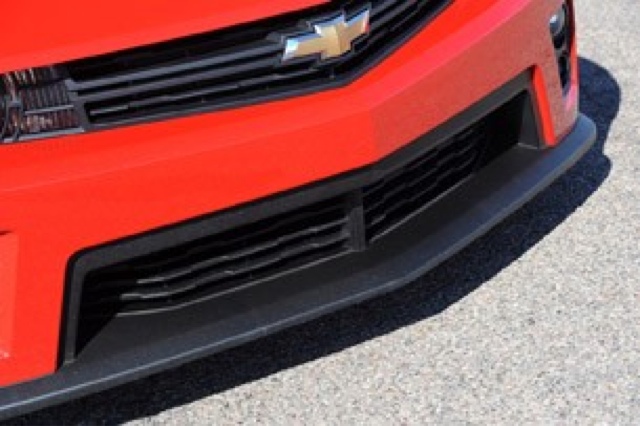
The Camaro ZL1's 6.2-liter supercharged V8, which shares its basic spec sheet with the Cadillac CTS-V and Chevy Corvette ZR1, puts out 580 horsepower at 6,000 rpm and 556 pound-feet of torque at 4,200 rpm. The official 0-60 time is 3.9 seconds and the quarter mile is dispatched in 12 seconds flat. Top speed is listed as 184 miles per hour, thanks in part to an aero package that includes a new front fascia, a carbon fiber hood with functional air extractor vents and an undertray with NACA ducts for cooling.
Those data points still matter in a big way, and will undoubtedly be the most oft-quoted stats by Ford Fanatics and the Bowtie Brigade. But, these days, you've got to be able to do more than go fast in a straight line to impress the true diehards.
And that's where the orange corner is placing its bets with the ZL1. Perhaps the most significant change to the ZL1 over its SS sibling, besides the supercharger, of course, are the magnetorheological dampers fitted at all four corners. We've seen this technology on a number of high-performance vehicles – from various Ferrari GTs to GM's own Cadillac CTS-V and Corvette ZR1 – but these shocks boast a new generation of both hardware and software that makes it all tick.
Chevrolet makes full use of the MR shocks' computer-controlled adjustability with the ZL1, and it pays big dividends on the track. The driver can choose from five settings using a trio of buttons just ahead of the shifter on the center console. A quick two-tap routine engages Performance Traction Management mode. The first stage of PTM is for adverse weather, and in the sunny climes of Arizona, we skipped it. PTM Mode Two affords moderately skilled drivers – even those unfamiliar with the car – the ability to have fun on a track with little danger of losing control. Modes Three and Four gradually allow more tire slip, stiffen up the Magnetic Ride Control and quicken the steering for drivers who have outgrown Mode Two.
And then there's Mode Five. This is the setting Chevrolet recommends for the track, and it's tuned to improve lap times of even the most highly skilled drivers. It works. Countless algorithms are programmed into all facets of the car's most technological bits and pieces, particularly the MR shocks and traction control. The suspenders get race-car stiff and the rear wheels are allowed just the right amount of slip to help a trained driver eke out the most corner exit speed possible.
The ZL1 rather impressively managed to lap the Nürburgring in seven minutes and 41 seconds.
Thankfully, the ZL1's brakes have also been upgraded to cope with the power of its engine. The six-pot Brembo pistons clamp down hard on two-piece ventilated rotors up front, while single-piece rotors with four-piston calipers do the deed out back.
To say we were impressed by the overweight Camaro's ability at Bondurant would be an understatement. With an official curb weight of 4,120 pounds, this car should be more of a linebacker than a ballerina. And it is. But it's a linebacker wearing a fluffy pink tutu and those crazy lace-up shoes with blunt-tipped toe boxes... and we mean that in the best way possible. After all, the ZL1 rather impressively managed to lap the Nürburgring in seven minutes and 41 seconds. That's almost 40 seconds quicker around the 'Ring than the 2009 Chevrolet Camaro SS.
If there's one place its devotees would expect the ZL1 to shine, it's at the drag strip. Bowtie fans will not be disappointed. The 2012 Chevrolet Camaro ZL1 will easily eat up 1,320 feet of asphalt and spit out a time slip in the low-12-second range. We know, we tested it in far-from-ideal conditions ourselves and have slips to prove it. It won't take much more than good weather, a manicured track surface and adequate seat time to drop a few tenths from the mid-12s at 114 miles per hour that we instantly recorded.
Part of the ZL1's race-car-in-drag performance can be attributed to good old-fashioned horsepower and wide, sticky tires. There are 20-inch forged alloy wheels at all four corners, available in either black 10-spoke or polished five-spoke designs, to which 285-front and 305-rear Goodyear Eagle F1 Supercar tires are mounted.
We also noted good throttle response, predictable clutch feel and a slick-shifting six-speed manual gearbox. These items alone should be all a seasoned drag racer needs to post the best numbers possible. For those who will only take their shiny ZL1 to the drag strip once or twice a year, Chevrolet has a trick up its sleeve to keep you from red-faced embarrassment and endless excuses.
PTM Mode Five is optimized for drag strip launches. As Chevrolet explains it, the starting line of a quarter-mile track is normally a death sentence for traction control systems. Right off the bat, a huge spike of G forces are loaded into the drivetrain at launch from the sticky surface, so the car gets full power from its computer. Then, the street tires (not low-pressure racing slicks) break traction, and all that power goes up in tire smoke. To combat this problem, the ZL1's PTM incorporates launch control into its bag of tricks. Nothing measurable is left to chance, from temperature and barometric pressure to the heat of the engine, the computer's megahertz-addled brain figures out the proper way to leave the lights.
Here's the step-by-step for launching the ZL1 in Mode Five: Pull up to the staging lights, mash the throttle and step off the clutch right about the time the last yellow light is lit. Keep your foot planted to the floor as you row through the gears – the ZL1 is equipped with no-lift-shift programming – until you pass the last set of timing lights. You've just managed a quarter-mile pass in the 12s. Congratulations are in order... there were only a handful of muscle cars in the 1960s or '70s that could manage such a feat, and they all command well over a hundred thousand dollars in today's horsepower-fueled classic car market.
Opt for the six-speed automatic and you'll be rewarded with eminently repeatable time slips.
Want to know a secret? There's an even easier way to dominate the drag strip. Opt for a 2012 Camaro ZL1 with the six-speed automatic transmission and you'll be rewarded with eminently repeatable time slips by following just one simple step: hit the gas. Well, first turn off the traction control completely and put the shifter in manual mode. But then hit the gas and let the transmission row the gears – the auto-equipped ZL1 will pre-select the next gear and upshift right at redline in this mode, though it will sit at its fuel-cutoff point all day long otherwise.
Would we buy the automatic? No. While the 6L90 gearbox is a fine unit, we'd choose the six-speed manual every day of the week. And while we're on the subject, we'll also mention that the steering wheel paddles of the auto-box'd ZL1 are flimsy plastic pieces that feel utterly out of place on a performance car.
There are downsides to the ZL1 package that apply to any Camaro model, including piss-poor visibility, overtly large exterior dimensions and an elephantine curb weight without the interior space to match. Worst of all, a complete dearth of headroom is exacerbated when wearing a helmet at the track. Finding a comfortable seating position was a big problem for our six-foot-two long-torsoed frame.
The Gas Guzzler tax should add $1,300 for a manual-equipped model and $2,600 for an automatic.
Finally, as you might expect, fuel economy is bad. Like, really bad. The EPA estimates you'll get 14 miles per gallon city and 19 mpg highway driving a ZL1, which means it's also subject to the federal government's Gas Guzzler tax. If its similarly tuned corporate cousin, the Cadillac CTS-V Coupe, is anything to go by, that should add an extra $1,300 to your tab for a manual-equipped model and $2,600 for an automatic. Ford fans will freak if we don't also mention that the more powerful 2013 GT500 is efficient enough to earn exemption from the GG tax. And naturally, the ZL1 only drinks premium.
Fortunately, there are a boatload of positives that manage to outweigh the negatives, including a comfortable ride from the magnetic shocks, a highly refined drivetrain and suede interior inserts that dress up the otherwise kitschy cabin. And, lest we forget the big V8 underhood, there's an active exhaust system that belches out one of the most glorious petroleum-fueled soundtracks in America, with just a hint of whine to remind you of the supercharger nestled atop the vee.
Perhaps the most impressive feat performed by the Camaro ZL1 isn't that it's fast – that's to be expected, right? – it's that the ZL1 will be fast for anyone, with almost any talent level, each and every time. And it will do so for the price of $54,095. That's certainly a lot of coin to spend on a Camaro, but we think it's a bargain in the world of performance. And the best part? All the go-fast goodies are standard equipment, including the magnetic suspension, PTM computer and heavy-duty cooling for the engine, transmission, brakes and rear differential.
The Camaro team seemed quite sure their baby would beat the 2013 GT500 around any race track with curves.
By comparison, GM reps are happy to point out that Ford recommends three additional coolers from its official parts catalog for any GT500 that will be subject to track use... and makes it clear that such use may result in the loss of warranty coverage. That is, at least for the 2012 model. Need we also mention the Mustang's live rear axle, as opposed to the fully independent setup affixed to the Camaro? As if to place the ball squarely in Ford's court, the Camaro team we spoke to at the ZL1 launch seemed quite sure that their baby would beat the 650-horsepower 2013 Shelby GT500 around any race track with curves... and possibly in a straight line.
While the upcoming ZL1 versus GT500 fight is sure to go down guns blazing, without having driven the future Shelby alongside this super Camaro, we're not ready to concede the victory to Ford based on spec sheets alone. Until both cars line up head-to-head, the endless pokings and proddings from Ford and Chevy fans will be nothing but a chorus of predictions.
Tags: 2012 chevrolet camaro zl1, al oppeneheiser, bondurant, camaro, camaro zl1, chevrolet, chevy, featured, first drive, FirstDrive, zl1
Subscribe to:
Comments (Atom)